Lab-Grown Diamonds vs. Mined — The Truth No One Tells You
Lab-Grown Diamonds vs. Mined: The Truth No One Tells You
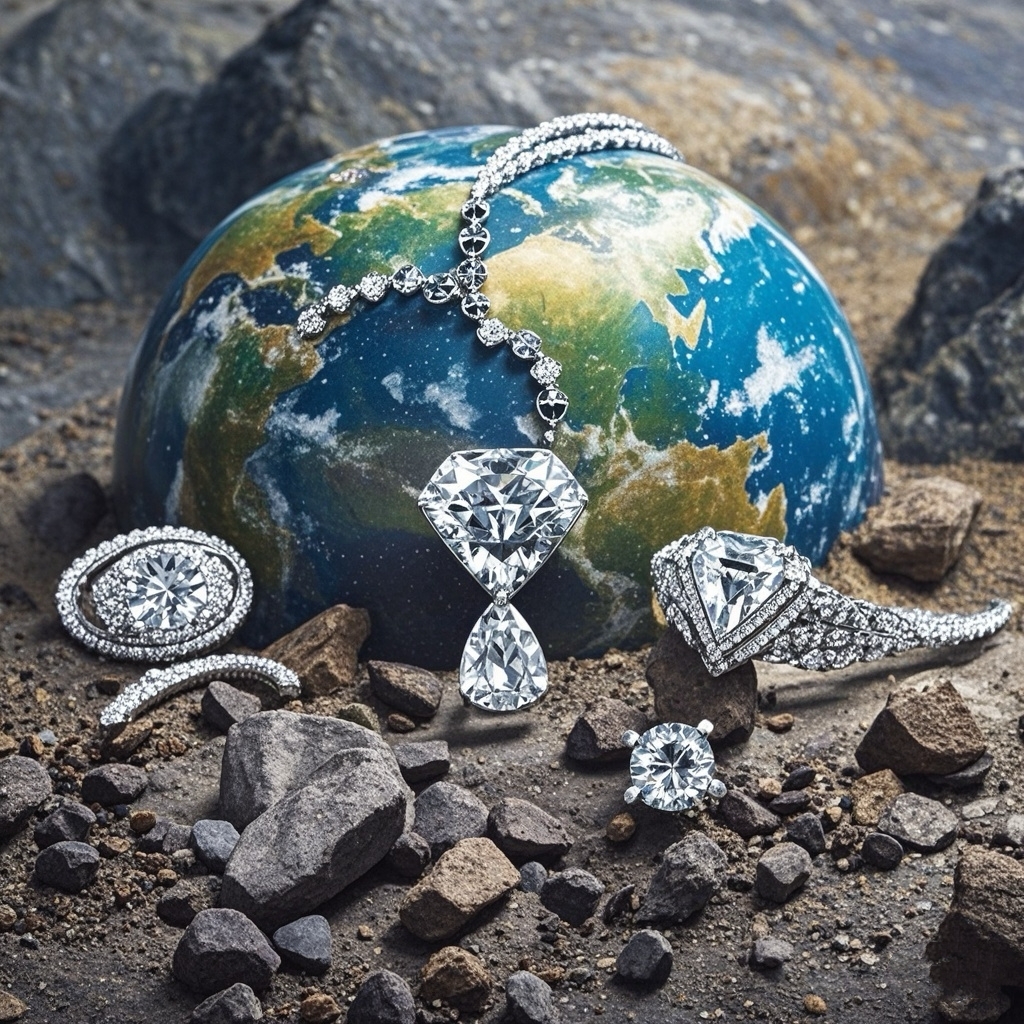
For over a century, the diamond industry has told us one story: a diamond's value comes from its rarity, its journey through billions of years, and its extraction from deep within the earth.
It's a beautiful story. But it's not the whole truth.
Here's what the diamond industry doesn't lead with: moving hundreds of tonnes of earth for a single carat. Opaque supply chains that make it nearly impossible to trace a stone's origin. And a carefully managed market where scarcity is manufactured to keep prices high.
Lab-grown diamonds change everything — not by being "fake" diamonds, but by being real diamonds with a cleaner origin story.
Are Lab-Grown Diamonds "Real"?
Yes. Unequivocally. A lab-grown diamond is chemically, physically, and optically identical to a mined diamond:
- Same chemical composition: Pure carbon, arranged in a crystal lattice.
- Same hardness: 10 on the Mohs scale — the hardest material on Earth.
- Same refractive index: 2.42 — that signature sparkle is identical.
- Same thermal conductivity: Diamond testers cannot tell them apart.
Even a trained gemologist needs specialized spectroscopy equipment to distinguish a lab-grown diamond from a mined one. Under a jeweler's loupe? They're indistinguishable.
How Are They Made?
Lab-grown diamonds are created using HPHT (High Pressure High Temperature) technology — essentially, recreating the volcanic conditions that form natural diamonds, but in a controlled laboratory environment:
- A tiny diamond seed is placed in pure carbon.
- It's exposed to temperatures of 1,300–1,600°C and pressures of over 50,000 atmospheres.
- Carbon crystallizes around the seed, growing layer by layer into a rough diamond.
- The rough diamond is then cut and polished — exactly like a mined stone.
The entire process takes weeks instead of billions of years. The result is a diamond that is, by every meaningful measure, identical to what comes out of a mine.
The Problem With Mined Diamonds
The traditional diamond industry has made significant improvements in recent decades — particularly around conflict diamonds (the "blood diamond" issue addressed by the Kimberley Process). But challenges remain:
- Environmental impact: Mining one carat of diamond requires moving approximately 250 tonnes of earth. This disrupts ecosystems, consumes enormous amounts of water, and leaves permanent scars on landscapes.
- Carbon footprint: A mined diamond produces roughly 57 kg of CO₂ per carat. A lab-grown diamond produces about 0.5 kg.
- Traceability: Despite improvements, a diamond's journey from mine to market can involve multiple countries and intermediaries, making full traceability difficult.
- Price inflation: Diamond prices are heavily influenced by supply control — not natural scarcity. The idea that diamonds are "rare" is largely a marketing construct.
Are Lab-Grown Diamonds Cheaper?
Significantly — and that's not a reflection of lower quality. It's a reflection of a shorter, more transparent supply chain:
- No mining costs: No earth moved, no heavy machinery, no mine rehabilitation.
- No intermediaries: Lab to cutter to jeweler — not mine to trader to dealer to wholesaler to retailer.
- No artificial scarcity: Supply is determined by demand, not controlled release.
The result: a lab-grown diamond typically costs 60–70% less than a mined diamond of equivalent quality. You get the same stone, the same fire, the same hardness — at a price that reflects what it actually costs to make, not what a century-old cartel has decided it should cost.
At LOTTEDS, we also offer Moissanite — a gemstone with even greater fire and brilliance than diamond, originally discovered in meteorites and now ethically grown in laboratories. Learn more about Moissanite →
The Bottom Line
A diamond is a diamond. What changes is the story behind it — and the price you pay for that story. If you value sustainability, traceability, and getting more brilliance for your budget, lab-grown is not just an alternative. It's the smarter choice.
Explore Lab-Grown Diamond Jewelry
Shop NowFull materials guide → · Read: PVD vs. Traditional Plating →
Leave a comment